
Dangerous and inspiring sleuths, part 2
Plus: How Not to (douche)Bag a F0urteener


Hi, friends. It rained in the mountains this past weekend, and the creek rose several inches overnight. More rain is in the forecast, and the Willow Fire to our north is 62-percent contained as of this morning. I’ve heard Mercury is no longer retrograde, which might account for the news that I will be talking about our canyon’s history to the Buena Vista Heritage Society next month. If you’ve been following along, you know that is the universe taking her usual joke’s-on-you lap. Apropros of nothing, let me just say here that I love most of my ghost-town neighbors.
Okay, on to part two of sleuths - amateur and professional - who inspired the heroine of my debut novel, Up to Her Neck. This week, I added a fun little bonus: short excerpts from these crime-solvers’ first appearance.
If you are here for cabin news/dish, scroll on down to the bottom, and as always, please:

4. Joyce Woollcott’s DS Ryan McBride
Ryan McBride’s neighbors make a perfect bap, and except for the grisly murders that blanket his desk like the rain in Belfast, he lives a fairytale life roaming the bog with his dog and brooding over a whiskey on his historic family estate. The lovely bap-baking neighbors even look after the dog when McBride’s tied up on an investigation–or entangled in an ill-advised relationship that could end his career in a spectacular tabloid style.
He’s often brooding on his own faults, which doesn’t make it any easier for him to control his ambition or his temper. But he distances them from his unerring police instincts just long enough to solve the case.
McBride is a devoted brother and friend, and a loyal partner to his sandwich-and-chips-obsessed desk-mate, Billy. He is a bit of a lad, but his rakish tendencies are undercut by his soft heart, which was tenderized and deep-fried by a motorcycle-riding femme fatale who deserves her own series. Measured against any James Ellroy detective, McBride is virtue incarnate, but I wonder what would happen if he were set loose in LA?
McBride’s entrance:
“They reminded him of mourners at a funeral.
“Down where the body lay, officers searched the undergrowth, their hands clasped behind their backs and their heads bowed.
“Detective Sergeant Ryan McBride pulled on his gloves. He should really grab a Tyvek suit, or booties at least, but he’d run out of patience, couldn’t be arsed to hang around any longer. Now that he was here, he wanted to get to the scene.”
What Wendy and McBride have in common:
• a hot temper
• an indispensable neighbor
• they keep their own counsel for too long
How they’re different:
• McBride loves the investigation. For Wendy it’s a distraction.

3. Kate Atkinson’s Jackson Brodie
Jackson Brodie is the Labrador Retriever of PIs. The women in his life abuse him like a Colorado rental car, and he puts up with it for reasons that become clear as you learn his tragic personal history. He’s the cautionary “No good deed goes unpunished” come to life, and he’s often sidelined on his own cases. He has to be rescued on occasion, too, and for a man who makes his living sussing out malefactors, he can be a poor judge of character.
But Brodie can’t walk away from a drowning person, even when they’re likely to drag him down, too. His doggedness and basic decency are the grounding force that hold Atkinson’s hubris-ridden criminals, eccentric bystanders, and absurdist plot twists together.
Brodie’s grand entrance:
“Jackson switched on the radio and listened to the reassuring voice of Jenny Murray on Woman’s Hour. He lit a new cigarette from the stub of the old one because he had run out of matches, and faced with a choice between chain-smoking or abstinence, he’d taken the former option because it felt like there was enough abstinence in his life already. If he got the cigarette lighter on the dashboard fixed he wouldn’t have to smoke his way through the packet, but there were a lot of other things that needed fixing on the car and the cigarette lighter wasn’t high on the list. Jackson drove a black Alfa Romeo 156 that he’d bought secondhand four years ago for £13,000 and that was now probably worth less than the Emmelle Freedom mountain bike he had just given his daughter for her eighth birthday (on the proviso she didn’t cycle on the road until she was at least forty).”
What Brodie and Wendy have in common:
• easily sidetracked
• fundamental decency makes them slow to recognize treachery in others
• don’t necessarily learn from mistakes
How they’re different:
• Wendy demands respect (not always successfully)

2. Denise Mina’s Paddy Meehan
I’d just finished the historical crime novel The Long Drop and enjoyed it so much I downloaded the next Mina title the algorithm threw at me and dug in without any idea what I was in for. A couple hours later, Paddy Meehan did something so stupid, so unethical, I would have thrown the book across the room if it wasn’t on my phone.
By this point, I was devoted to Meehan, the Platonic ideal of the grubby, ambitious reporter. Her parents disapprove of her work, her colleagues and clothes torture her. She makes enemies ten times faster than friends, and she’s not even trying to make enemies–imagine if she put some intention into it. (As with any good sleuth, the friends she does make are the ones worth having.)
I was so angry, I had to read on. How would Meehan redeem herself? At least she wasn’t (only) going for a scoop when she crossed the line. Meehan isn’t just a brazen female in a dick clique, she’s a Catholic in Glasgow, and shares her name with an infamous Catholic safe-cracker who claims he was framed for murder (Mina based that character on Patrick Connolly Meehan, and hewed closely to the facts). Reporter Paddy also shares a bit of persecution complex and a dangerous sense of her own importance with the criminal Paddy.
Our heroine’s considerable ego is undercut by occasional regret and persistent low self-esteem. She’s outgrown her devoted fiancé–she certainly doesn’t love him as much as her close-knit family does–but she hangs on too long out of comfort and a sense of security. She feels like a “fat lassie” in her sweaty jumpers and itchy stockings (a fellow reporter she’s crushing on confirms her assessment before hitting on her). Her wicked retorts mask a deeply embedded fear that she’ll be cast out of the club she only halfway wants to join.
What Wendy and Paddy have in common:
• family who offer conditional love and approval
• ready, fire, aim
• heedless of personal danger until it’s too late
How Wendy is different from Paddy:
• she has twenty-plus more years under her belt
Paddy’s debut:
“Paddy Meehan was standing at the Press Bar when she overheard Dr. Pete telling a crowd of drunks that he’d strangle the three-year-old himself if it would bring an end to the story. The men around him laughed and slowed and laughed again in a ragged wave. Dr. Pete sat still among them, looking even more desiccated than usual, his features organized into a smile around his heartbroken eyes. She watched his reflection in the mirror behind the bar. His bushy eyebrows billowed out from a face scarred by a decade-long hangover. He lifted his glass to his mouth, eyes shut, feeling for the rim with the gray tip of his tongue. Rumor had it that he was a bigamist.
“Paddy didn’t like the men or want to keep their company, but she did want to have a place among them, to be a journalist instead of a gofer. She would have felt like an interloper in the bar if she hadn’t been on News business, here to get the picture editor’s tankard filled.”
Next week: Number 1! I bet you can guess who it is.
____________________________________________
How Not to (douche)Bag a Fourteener
The first two summers we spent at the cabin, we soaked in a hot tub on a platform less than twenty feet from the road. We didn’t need to wear suits; hardly anyone drove by. Six years later, there’s a full-on rush hour three times a day on weekends, and M-F aren’t exactly quiet. The cities within a few hours drive have grown dramatically over the past two decades, and social media has lured people outdoors for fame and bragging rights. But the cars flying up and down our forest road are mostly headed one place: a fourteener.
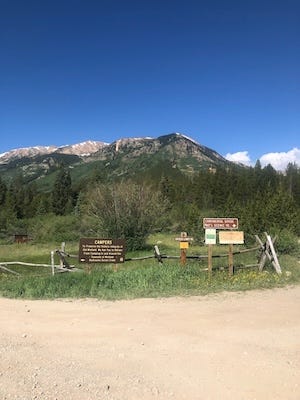
A fourteener is a mountain with at least 14,000 feet of elevation (there are a couple other qualifying stats that you can read about here). Colorado has 58 (depending who’s counting), more than any other state. You can reach five from the road that leads to our cabin.
Hiking to the top of a fourteener, or “peak-bagging” as it’s sometimes regrettably called, has become a pastime pursued with the same intensity as CrossFit. The length and elevation gains vary from mountain to mountain, but they finish with a scramble through scree fields and thin air. People can become addicted after their first summit, and the addicted often treat it like another task on the fitness app: Get in, get up, get out before the sun sets again.
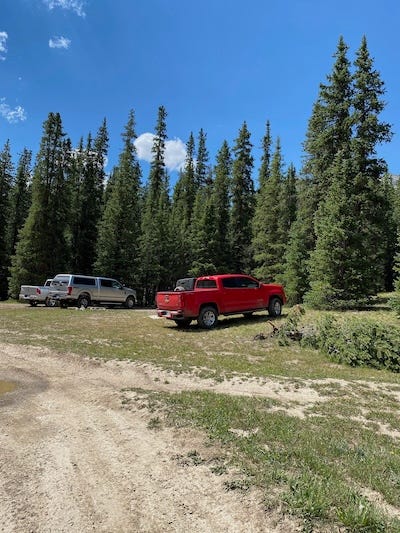
We moved our hot tub behind the cabin and we avoid the front yard during rush hour, but no one can avoid the traffic jams at the trailheads. Cars overflow the gravel lots, line the single-lane roads, squeeze into gaps in the bushes, ignore no-camping signs. If you arrive at the trailhead after 6 a.m. on a fair-weather weekend, there’s unlikely to be an open parking spot.
That’s typical Saturday overflow parking, above, at the Missouri Gulch Trailhead, which offers direct access to three fourteeners.
The Colorado Fourteeners Initiative estimates that more than a quarter-million people summit the state’s fourteeners each season, which runs roughly from June to October (although with dryer, warmer winters, people are pushing that window).
That means on busy days hundreds of climbers are on any given summit trail. The impact of this fixation can be seen on the roads, the trails, the trailheads, in the tiny towns that serve as gateways. But CFI, the leading organization dedicated to preserving the peaks is focused almost exclusively on the tundra, above treeline.
The tundra is extremely fragile, and it doesn’t heal quickly or easily. Back in the 90s, when a coalition of outdoor and government organizations formed CFI, enthusiastic alpinists were creating multiple routes to the state’s summits, tearing up the landscape as they went.
A couple years ago, I contacted Lloyd Athearn, executive director of CFI, to ask if he’d speak to our local historical society about the increased traffic, and how we might be able to help with education and outreach to mitigate the wear and tear on the wilderness.
His (testy) reply? There was no increase. He cited numbers based on a static counter and some modeling to estimate foot traffic. My neighbors and I live at the intersection to two trailheads, I said. At least one of us is there each weekend, and my friend Hilary lives there all summer, ten feet from the road. We were watching it happen in real time.
I mean, who am I going to believe, your estimated stats or my own lying eyes?
But let’s accept his numbers for a minute …
My neighbors and I live on the road to Mount Huron, which is promoted as the easiest fourteener for beginners. And this may be true, if you don’t take into account the road to the trailhead, which makes the Worst Road in North America look like newly laid blacktop.
According to CFI, seasonal peak-bagging on Huron topped out around 12,000 in 2020, and has since dropped back to closer to 7,000. We’ll go with the lower number. Peak-climbing season is confined mostly to July through early September, but we’ll extend it for this example. Let’s call it 24 weeks, from mid spring through late fall. That’s 300 people per week, on a single trail. If they spread it out evenly over the days, you’d see just 43 hikers each day, but that’s not what happens. Holidays, weekends, and the warm, sunny days of mid to late summer draw the most traffic.
A friend who has summited Huron multiple times counted 200 climbers on the trail one Saturday last year. Two hundred is quite low for some of the busier peaks, but the trail to this particular summit runs alongside designated wilderness, where even bikes are prohibited.
Ironically, if you wanted to take twenty of your friends on a backcountry hike from the same trailhead that leads to Huron, you would need to apply for a permit from the Forest Service. But 200 unorganized people can drive their cars up the old mining road and head up the trailhead together, which is exactly what happens.
To summit safely, you have to start well before the sun is up, take the selfie, and return below treeline before midday storms roll in. Cars roll by the cabin from three to five a.m. during peak peak season, nose to tail like horses on a guided trail ride, then back out between one and four p.m.
Anyway, Lloyd’s and my conversation did not improve from there. He belittled the historical society and suggested that as someone who moved here from out-of-state, I was the problem – like more than half the residents of Colorado, I guess.
Later, after the shock of his hostility wore off, I realized that what he’d heard me saying was something he might deeply fear: They are losing the battle.
A key part of CFI’s philosophy is that, “A small number of hikers engaging in impactful behaviors can cause a greater amount of damage to native vegetation than a large number of hikers using minimum impact techniques.”
But at some point that math collapses on itself. The organization spends 6 percent of its budget on education – a little over $125,000 (2024 numbers, the latest available on the website). Cruise on over to 14ers.com (CFI is 14ers.org), and you’ll see how little impact “Stay the Trail” and other sustainable messaging is having on the community.
So, in the spirit of service to the community, here are some tips for not (douche)bagging a Fourteener:
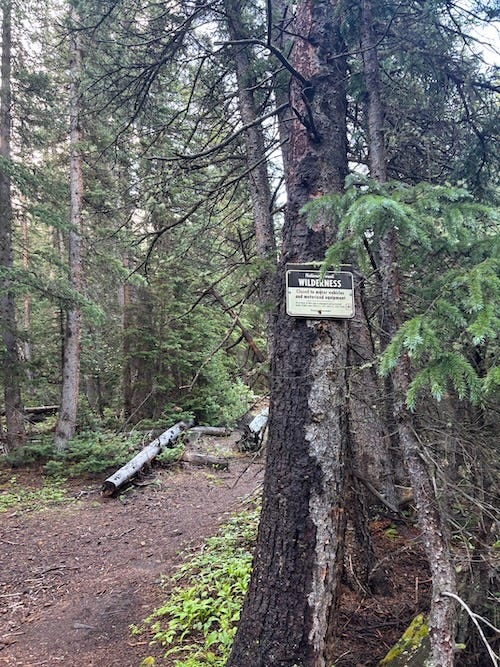
Where is your mountain? Check the map. Is it in or bordering a Wilderness Area? If so, leave the drone at home, and follow the other Wilderness rules, which are stricter than those for National Forest or BLM land. Remote trailheads often will not have toilets, so plan to handle that in a responsible fashion, too.
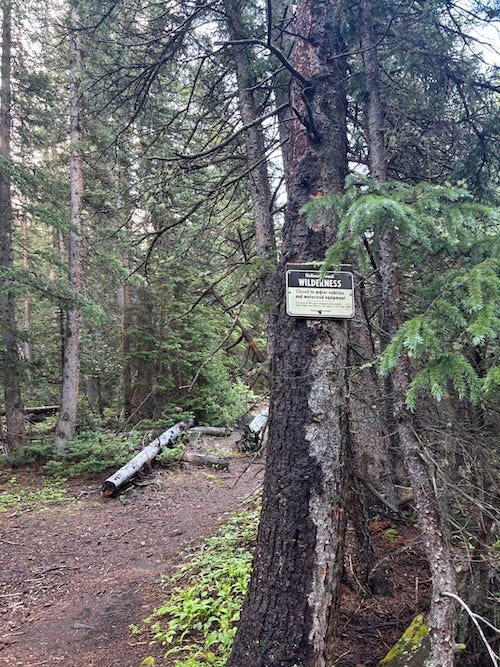
Leash your dog, or even better, leave him/her at home. Above the treeline and tundra, you’re scrambling over scree fields that are hard on your four-legged friends’ paws, and dangerous. Your pet can also disturb wildlife, and it’s so easy to miss their poop if they’re running around unmonitored.
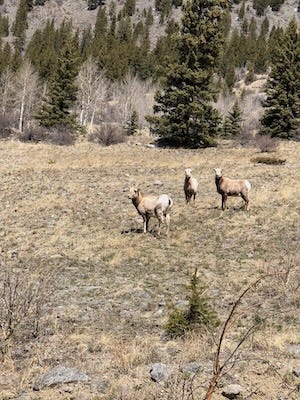
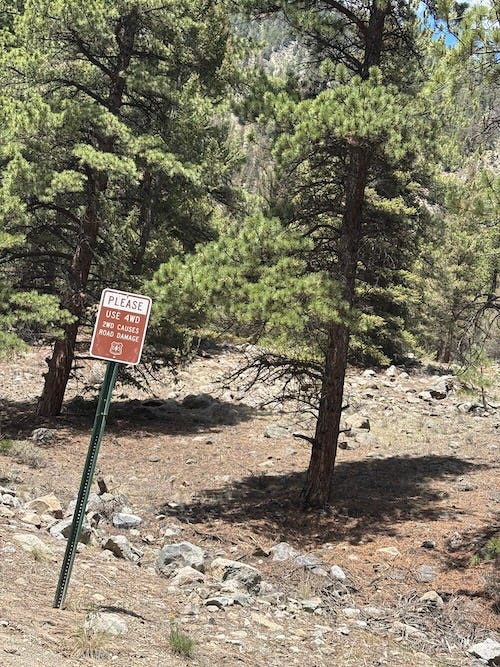
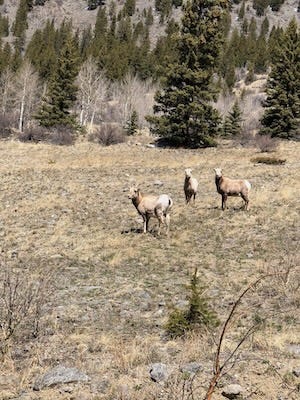
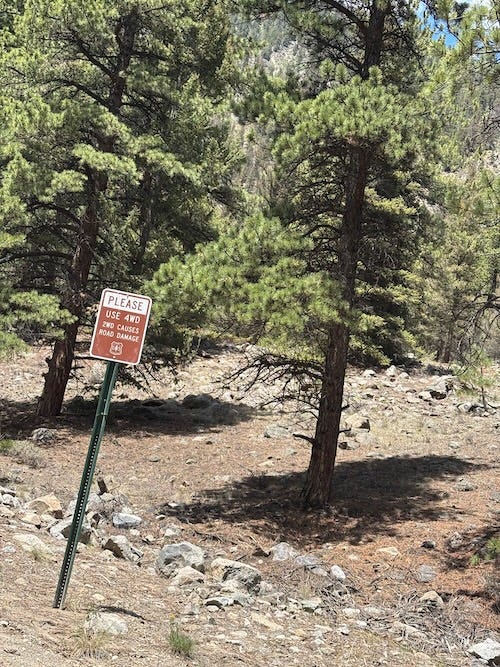
These guys don’t care about your fourteener stats, and they definitely don’t want to meet your dog. Observe the signs. 4WD Only? It’s not just for your protection (or to discourage business for Gunsmoke Towing and their peers). 2WD tears up gravel roads that are already in rough shape. Is a lot reserved for a museum or shop? Don’t park your car there for six hours.
Stay the Trail. Everything around you is habitat for something: native grasses, lichen, chipmunks, elk, big-horned sheep, moose. Don’t enlarge the human footprint by cutting around wet areas or taking a shortcut.
Speaking of elk and moose, maintain a safe distance from wildlife: at least 100 yards from bears, and a minimum of 25 yards from other large animals. You don’t need that selfie with Bullwinkle.
Carpool! Parking is limited at the trailhead, especially in remote wilderness areas. Find a friend who summits, too, and share the ride.
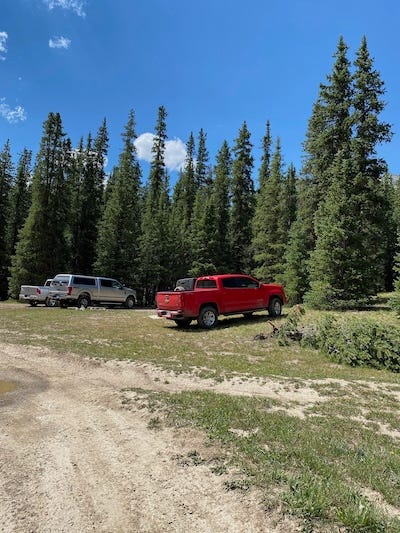
Habitat on its way to becoming more parking lot. Leave No Trace. Just what it sounds like.
Don’t camp at the trailhead. Camping is prohibited at most USFS trailheads, and yes, sleeping in your car counts.
Drive the speed limit. Our ghost town has a posted limit of 10mph, which no one obeys, despite the poor visibility, rough terrain, and sharp T corner ahead. In front of our cabin, it’s 25 mph, but drivers fly by, oblivious to the sign warning that kids and pets are at play. Be considerate: One woman’s Middle of Nowhere is another woman’s home. If you don’t see a posted limit, assume it’s 35mph, the USFS default.
Check the current fire regulations and make sure any fire you start is “Dead Out” before you leave it unattended.
BONUS: If the trailhead is overflowing, turn around and find another trail to hike. Save the peak for another day.
YOUR SUGGESTION HERE:
Thanks for reading, as always. See you next week.
XX
Elaine
Great piece! And I love the shoutout to Joyce Woollcott!
Thank you for this - you just gave me some new books to check out from the library!