
Solving problems I created, one trash run at a time
And some thrilling summer book news!

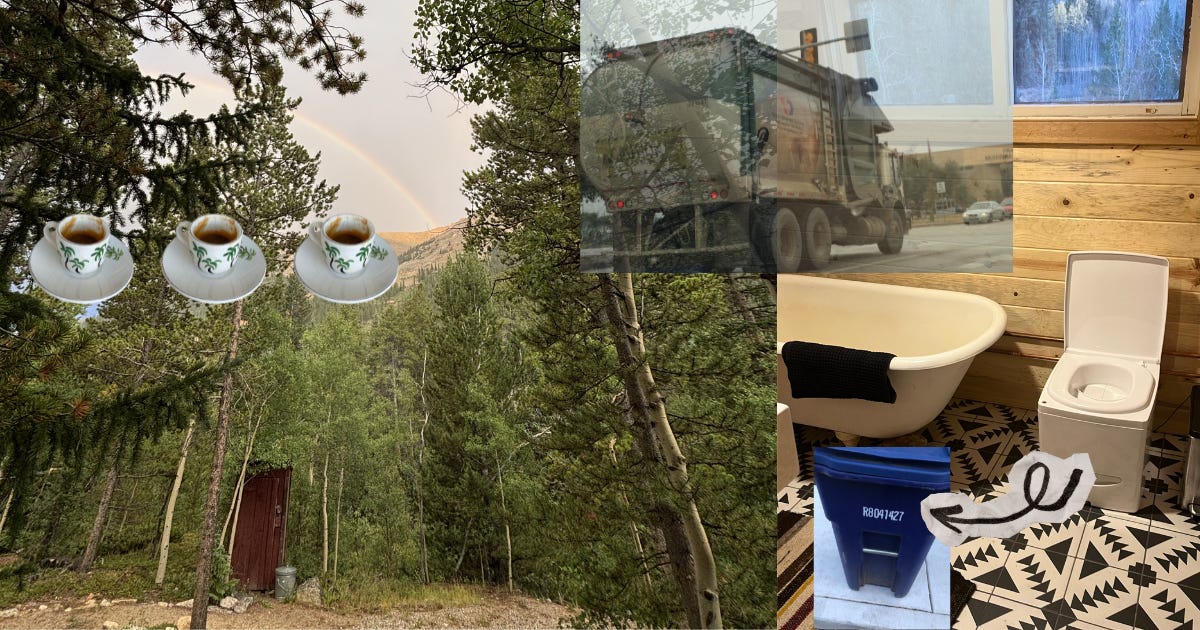
I watched the garbage truck come by last Thursday morning. It passes just below the in-town bedroom window where I have my espresso. The metal arm shoots out, clutches the charcoal-gray bin, and upends it into the truck with a house-shaking thunk. I was keeping an eye out for one particular bag, matte contractor black, square like the object inside of it, and I sighed with relief as it slid into the great maw at the back. Farewell, little composting toilet. You were a failed experiment, and an expensive one. I hope to never think of you again.
“Toilet” is such a grand word for what was a white plastic box, smaller than a laundry hamper, and less complicated than a French-press coffeepot. I’m sure most people manage to operate them without incident.
The composting part of the toilet, which dealt with “solid waste,” used coconut coir to absorb odors and maintain a remarkably neutral and unthreatening setting. The coir comes in light-brown desiccated bricks that rehydrate with water and turn into an earthy, mahogany-colored fluff that, when fresh, evokes the very essence of the Summer of Love. (Also when not fresh. See: Woodstock).
I’d learned the previous summer that one brick isn’t quite enough, so this year I wedged two blocks under the hand-cranked turbine and poured in enough liquid to plump them back up.
That’s where they remained for the remainder of the little potty’s life. They swelled up so tightly under the turbine’s shaft that the crank would not crank, no matter how much cussing and pressure I applied. I sawed at the material like a possessed logger with a bread knife that has since been retired (I mean, ew), aerated it with a tool meant to roast multiple marshmallows over a fire (also retired), added water, removed water, dropped it from small heights like an orangutan with a new toy.
Eventually, the coir resembled a flooring material Mike Brady might have specified for one of the houses he designed. But the crank never cranked again, which unfortunately is a key part of a composting toilet. At that point it was just a high-priced pee jar — with a potential growing medium hiding under the rear portion of the seat.
I bagged it up and hauled it back to town, feeling furtive and embarrassed about the whole episode. Would I have to smuggle it into a construction dumpster? Would I get one of those illustrated scolding handouts from the trash company, threatening to cut us off if we didn’t follow the rules? Will I recall it with a pang of guilt every time I read about the Pacific trash gyre?
Or could it function as a small reef, like a miniature version of the ships they sink?
The evidence dropped with a whisper of plastic on plastic into our trashcan and a few days later, my new favorite service provider trundled it away.
Michael didn’t miss it. He maintains no man was involved in its design. The “bowl” wasn’t deep enough to accommodate the male equipment when seated.
Back to the outhouses we went.
Our cabin most often hosts two people for a few nights at a time, so the existing privies, which sit over old-fashioned pit toilets really are enough. When I bought the composting toilet, I was trying to mail-order a solution to two short-term problems: the wee-hours call of nature, when mountain lions and bears might be about; and the morning constitutional, when one does not want to be thinking about spiders close to thine nether regions.
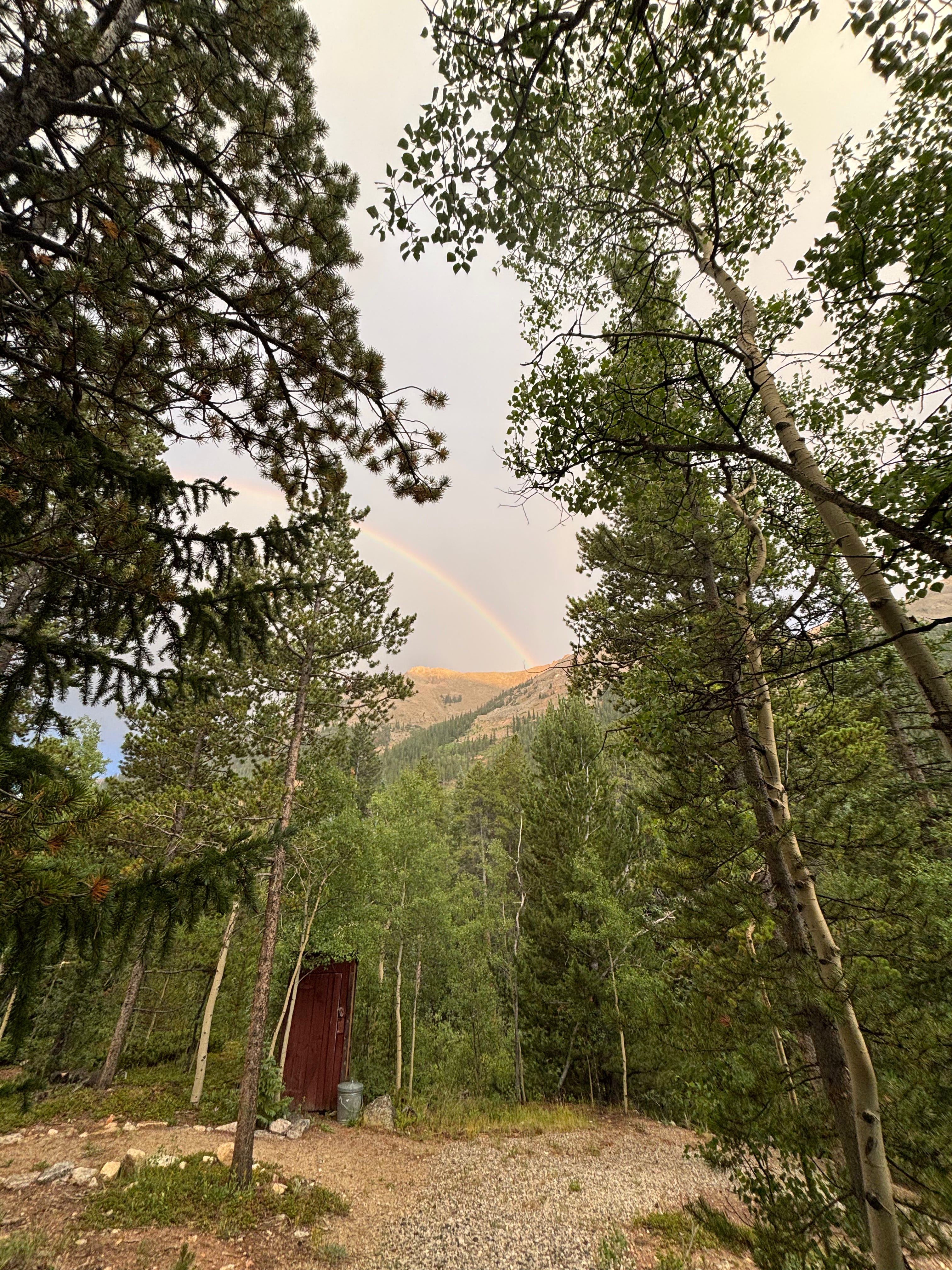
It’s not just that I have to solve these problems, which I seldom think about when I’m among civilization’s concealed pipes and porcelain thrones, I have to solve them as a good custodian of nature. I’ve considered those clever Japanese toilets that turn your waste into sealed pellets, but I’m almost positive those plastic packets would not make good artificial reefs when they eventually end up in the ocean.
I also hoped a simple composting toilet would solve a long-term issue: I’ve had the pits under our outhouses pumped three times. It cost a half grand each time, which included a $100 surcharge for driving up The Worst Road in North America. It was a jarring process, which involved Jose G. parking his large tanker truck in the front yard and running a motor that sounded like the trash compactor from Star Wars while we shouted short exchanges about his wife’s teaching career and the Western Flycatchers chewed us out from a safe distance. But done, phew, piece of cake overall.
He stopped answering my texts, however, after he was attacked by wasps who’d built a delicate paper nest in a dark corner of the green and pink outhouse we call the Watermelon. I guess the wasps were unbothered by our daily comings and goings, but the earthquake-like vibrations of the honey wagon provoked full mobilization.
Jose was rumbling back down the road when I waved him over. He refused my offer of a pain reliever and an antihistamine. It was clear he didn’t believe we had no idea there was a wasp nest in there.
Our neighbor Christine found a scrappy pumper with a small company who was willing to service our area. Unfortunately, he was smaller all over. His equipment wasn’t long enough to reach our lower honeypot … and he wanted $100 more just to do the one. He ghosted us all after a couple of visits, too.
I started making plans to retire the outhouses and replace the mysterious septic system/mine shaft of lore, but Rocky, another one of our lovely neighbors, recently volunteered to take over the search for an operator who will handle all the town’s privies. It’s a thankless task that involves explaining the location of our tiny ghost town, calculating volume, and hearing the word “no” a lot. He also has to coordinate with the residents who lock theirs up when they’re gone.
An alternative to privy padlocks might be to put out a donation can for contributions toward the cost of pumping. I wonder how many passersby would leave a deposit in both receptacles?
More frequent pumping isn’t the only problem that could arise in an unsecured loo. It seems like every year a hiker ends up ends-up in a Forest Service tank trying to retrieve a phone or other personal object. A question for the Colorado personal-injury attorneys out there: Are my neighbors and I liable if we don’t secure our private vault toilets and an uninvited user takes a dunk?
Tell me about an expensive or impractical purchase that didn’t solve your problem, either! Do you still have it? Did you find another purpose for it? Does anyone in your life say, ‘told you so’ when the subject comes up?
Don’t forget to pack compostable tp for your CO trip, and leave a couple of bucks if you take advantage of an unlocked loo.
_______________________________________
BOOK NEWS
I’ve been quiet lately because I’m working on a fun project with my publisher, Alisa Kennedy Jones and Empress Editions: a limited interactive series starring Up to Her Neck’s amateur sleuth, Wendy McFarquhar, and her quirky neighbors in the town of Lucknow. It’s inspired in part by unsolved Colorado mysteries, like this:

And this:

Follow @elainemwolff and @the.empress.age on Instagram now and help Wendy solve the case when it goes live. Our guiding light: What would Nancy Drew do? COMING SOOOON!!
Also! I’m officially onboard for the Scottsdale Book Festival, January 30, 2027, at the Scottsdale Civic Center. Come on by! I’ll be signing copies of Up to Her Neck, and talking all things Colorado, mystery, thriller, and off-grid adventure.
Happy summer, y’all. Tell me what you’re up to in the comments.